Have you ever had something to say in a meeting and missed the moment?
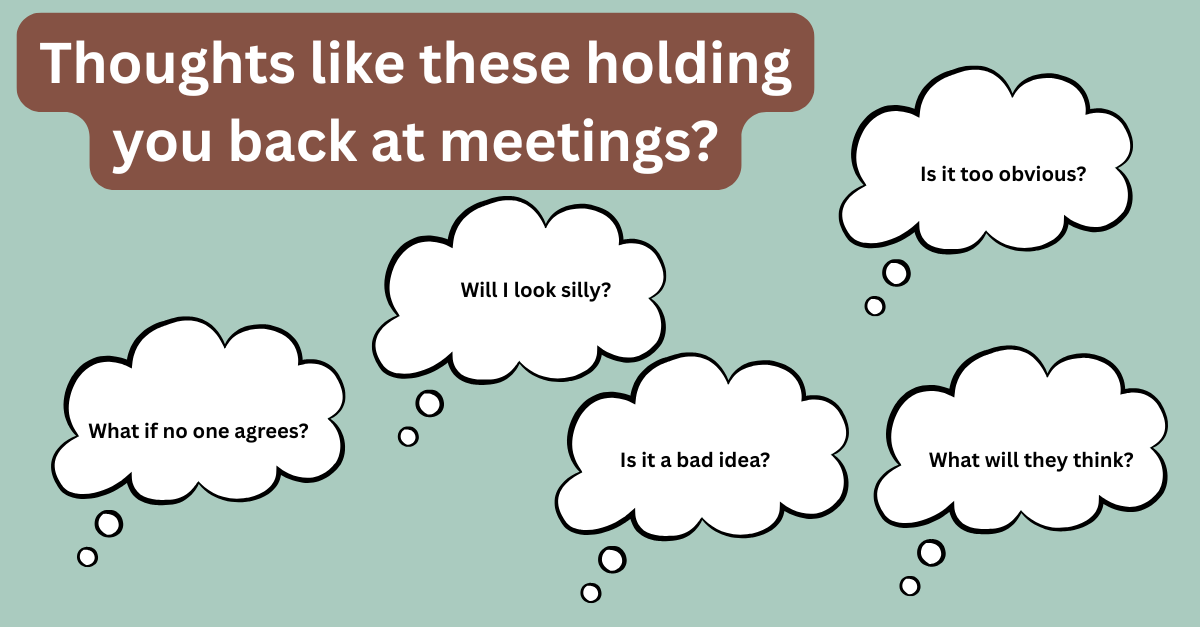
You start forming the thought. You might even mentally rehearse how you are going to say it. Then the hesitation creeps in. You question whether it is useful, whether it is obvious, and whether you will explain it clearly. At some point, you may even wonder if it is a silly thing to say.
So you wait. And then the conversation moves on. Or someone else says it first.
It is frustrating, and for many people, it is not a one-off. It is a pattern.
It’s not a lack of ideas
When clients bring this up, they often assume the issue is a capability one. It rarely is.
In most cases, they have good instincts. They are paying attention. They are thinking about the discussion in a useful way. The problem is not the quality of their thinking. It is what happens in the gap between thinking it and saying it.
That gap fills up quickly
A running commentary starts in your head. You begin to evaluate your own contribution before anyone else has even heard it. You try to refine it, shape it, and anticipate how it will land. All of that takes time, and meetings do not wait.
While you are still deciding whether to speak, the moment passes.
A familiar client pattern
A client mentioned this to me recently. She had a good example of a success story that would have added something concrete to the discussion. It was relevant and timely.
But she noticed that others were not contributing much, and she interpreted that as a signal. Maybe this was not the right moment. Maybe it was not expected.
The meeting moved on and the opportunity went with it. Afterwards, she was annoyed at herself, not because she did not know what to say, but because she had talked herself out of saying it.
If you recognise this, you are not alone. I see this pattern a lot, particularly with thoughtful, capable people who are used to holding a high standard for what they say.
Why the hesitation happens
A few things are going on in that moment.
First, there is a desire to get it right. You want your contribution to be clear, relevant and well-received. That is reasonable, but it can easily tip into over-editing in real time.
Second, there is an awareness of how you might be judged. You worry that your idea is not great, or that others may disagree.
And third, there is a misunderstanding of what meetings actually require.
Most people assume they need to contribute something fully formed and well-articulated. In reality, that is not how most meetings work.
What meetings actually need from you
Most contributions in meetings are not polished or profound. They are incremental.
A question that moves the discussion forward. A small piece of information that adds context. A perspective that helps others think differently. Often, the value is not in the contribution on its own, but in what it enables next.
You may say something that someone else builds on. You may raise a point that shifts the direction slightly. You may simply say out loud what others are already thinking but have not voiced.
If you hold yourself back until your contribution feels complete and fully formed, you will often miss the point at which it would have been most useful.
What to do differently
There are three shifts I encourage clients to make.
Get in early
The longer you sit with a thought, the more time you give that internal commentary to take over. Early contributions do not need to be perfectly structured. They just need to be relevant enough to move things forward.
This might mean speaking sooner than feels comfortable.
Aim for useful, not perfect
Lower the bar slightly. You are not trying to deliver a mini presentation. You are adding to a live conversation.
Before you speak, a simple check can help: Is this useful enough? Not perfect. Not brilliant. Just useful enough.
That is a much easier standard to meet, and it is far more aligned with how meetings actually work.
Accept that it will not always land perfectly
Sometimes your contribution will fall a bit flat. You might not explain it as clearly as you intended. There may be a pause, or the conversation may move on quickly.
It can feel uncomfortable in the moment, but it is rarely as noticeable or as important as it feels. Most people are focused on their own contributions, not analysing yours.
And occasionally, what feels like a flat contribution has more impact than you realise. Others may be thinking about it, even if they do not respond immediately.
Final words
In your next meeting, give yourself a simple rule.
Contribute once, early.
It does not need to be your best point. It does not need to change the direction of the discussion. It just needs to be relevant.
Once you have spoken once, it becomes much easier to speak again.
And over time, that one small decision can change how you are seen and how you see yourself.
