When I first wrote about Zoom panic during Covid, many people were surprised to discover that their public speaking anxiety had followed them online.
They had assumed that speaking from home would feel easier. No stage, no meeting room, no rows of faces looking back at them. Just a laptop, a familiar room and maybe a cup of coffee within reach.
For some people, that was exactly how it felt. Online meetings gave them some distance from the room. They could use notes more easily, control their environment and avoid some of the physical exposure of standing in front of people.
But for others, online speaking was not easier at all. In some cases, it was worse. And I even had clients experience public speaking anxiety for the first time!
Several years on, most of us are far more used to online meetings. We know how to unmute, we know where the chat is, and we know how to share our screen without quite the same spike of panic. But that does not mean everyone now feels confident speaking online.
Among my clients, I still see big differences. Some are comfortable presenting on Teams or Zoom and find in-person speaking much more anxiety-inducing. Others can manage a room reasonably well, but find online meetings strangely exposing, flat or hard to read.
Recent research helps explain why. Online speaking brings its own pressures: seeing yourself on screen, trying to read weak audience cues, feeling watched by multiple faces at once, dealing with silence, and managing the extra effort of appearing engaged while also trying to communicate clearly.
But there is another factor I see often in my coaching work, and I think it gets less attention.
Online meetings can make it harder to build the relationships that help people feel safe enough to speak.
Online speaking is not easier for everyone
One of the mistakes we make is assuming that online speaking is simply a smaller version of public speaking.
It is not.
In some ways, online speaking can reduce pressure. You may be sitting in your own home or office, with your notes nearby and no need to walk to the front of a room. You may also feel less physically visible, which can make the whole experience more manageable.
For some speakers, the screen creates just enough distance to take the edge off their anxiety.
For others, the screen adds pressure. You can see yourself while you are speaking. You may be aware of your face, your lighting, your background, your expression and whether you look nervous. Instead of focusing on the people you are speaking to, part of your mind starts monitoring your own performance.
That self-monitoring adds to an already overloaded bandwidth.
In an in-person meeting, you may be aware that people are looking at you. Online, you may also be looking at yourself. You are speaking, watching yourself speak, checking how you appear and trying to read everyone else at the same time.
No wonder some people find it harder to think clearly.
The online audience is harder to read
Anxious speakers often want reassurance from the audience, even if they do not realise they are looking for it.
They want a nod, a smile, a look of interest, someone leaning forward or a quick “yes, that makes sense.”
In a room, you can often feel whether people are with you. Not perfectly, of course. We can still misread people in person, but there is usually more information available.
Online, many of those signals disappear or become harder to interpret. A thoughtful pause can feel like disapproval. A blank face can feel like boredom. A camera-off participant can feel like rejection. A slight delay can feel as though your point has landed badly, even when it is only the technology getting in the way.
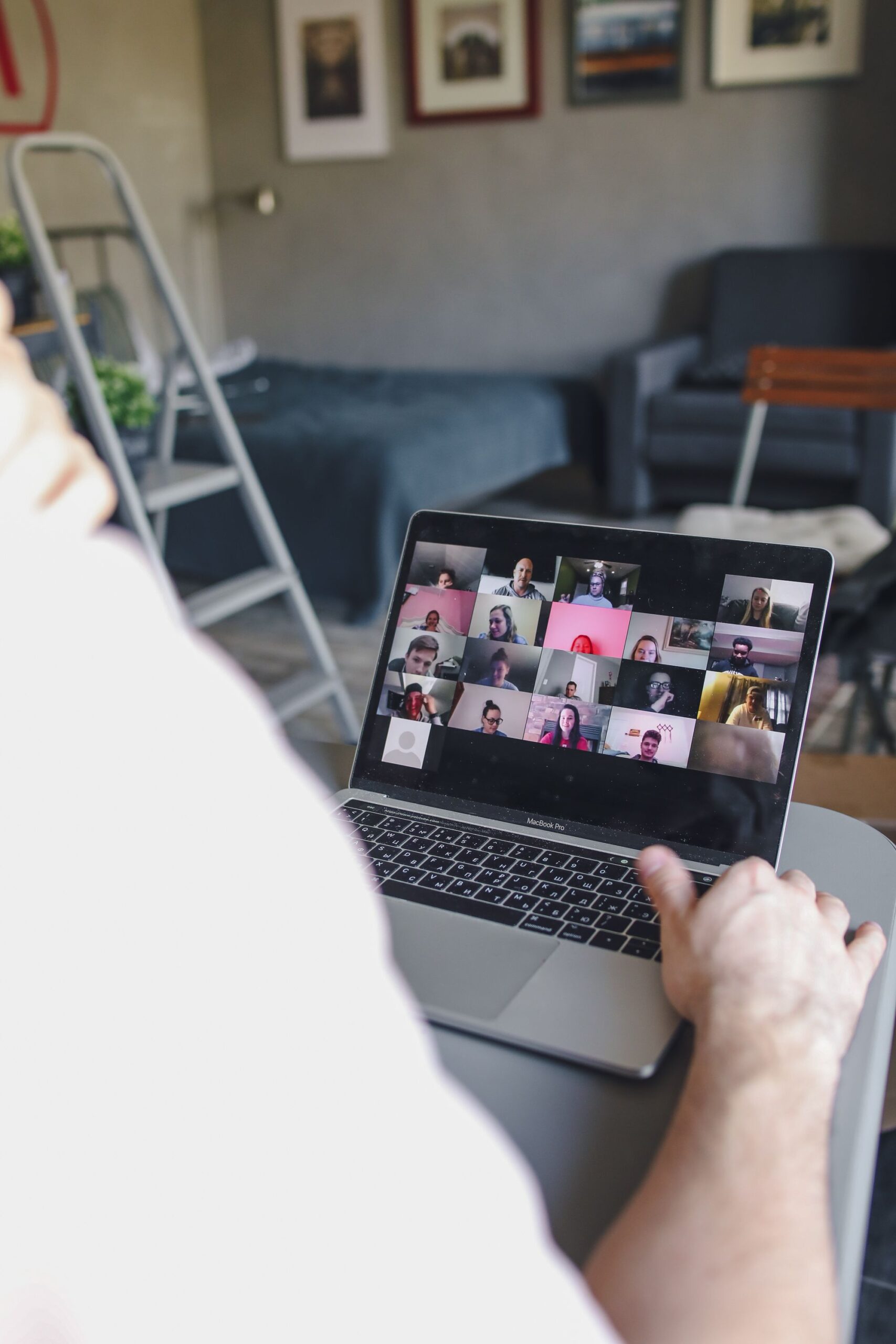
There is also the strange disconnection of speaking into a screen. You may be talking to a grid of faces, initials, black boxes or one small camera light at the top of your laptop. It can feel less like a conversation and more like sending words into a box and waiting to see if anything comes back.
When you cannot feel the audience, you can become more aware of yourself. Your attention moves from “What do they need from me?” to “How am I coming across?” You start noticing your voice, your face, your expression, your pauses and whether you sound confident enough.
This is one reason online meetings can feel particularly difficult for people with public speaking anxiety. They are already scanning for signs that something is going wrong. Online, there are fewer reliable signs to read, so the anxious brain starts filling in the gaps.
And it usually does not fill them in kindly.
The relationship layer
This is where online speaking anxiety can become more than a fear of presenting.
I have seen this with a client I will call Chloe. Chloe is in a relatively new strategic role. She is highly capable and technically strong, but her role now requires more than expertise. She needs to influence, facilitate and help others think differently, often without having direct authority over them.
That is hard enough in person. Online, it becomes harder.
Chloe is not only trying to explain her ideas clearly. She is also trying to build trust with people she may not know well, read the mood of the group, work out when to contribute, and judge whether silence means agreement, resistance, distraction or simply a slow internet connection.
When relationships are still new, every contribution can feel higher stakes.
Should I say something now? Will this sound too obvious? Will they think I am pushing too hard? Have I understood the politics in the room? Is this the right moment?
These questions are not just about nerves. They are about context. When you have not yet built strong working relationships, it is harder to trust that people will interpret your contribution generously.
That is one of the hidden difficulties of online and hybrid work. Influence often depends on the small moments around the formal meeting: the conversation before people sit down, the quick chat afterwards, the informal check-in, the chance to notice how someone responds when the pressure is lower.
Online, those moments do not happen as naturally. You often enter the meeting at the scheduled time, move straight into the agenda, then everyone disappears as soon as it ends.
For someone like Chloe, the speaking challenge is not simply, “Can I present this information clearly?”
It is also, “How do I build trust with people I rarely see in person?”
New roles make this harder
Online speaking can be especially challenging when you are new to an organisation, new to a role, or moving from a technical position into a more strategic one.
In a technical role, your expertise may be the main thing people need from you. In a more strategic role, expertise still counts, but it is not enough. You also need judgment, timing, influence and the ability to bring people with you.
That means speaking becomes more relational.
You are not just transferring information. You are helping people understand why something needs their attention, where the risks are, what choices they have and what might need to happen next.
If you are doing that in a room full of people you know well, the relationship carries some of the weight. If you are doing it online with people who do not yet know you, the words can feel as though they have to do all the work.
That is a lot of pressure to put on one contribution in one meeting.
What helps?
The answer is not to tell yourself that online speaking should be easy. That usually makes people feel worse.
A better starting point is to understand why it feels hard, then build the skills around that reality.
Hide self-view once you have checked your setup.
If seeing yourself makes you more self-conscious, do the quick practical check at the start. Lighting, camera, background, done. Then hide self-view if the platform allows it. You do not need to watch yourself speak.
Ask for cameras on when it is reasonable.
If you are leading a meeting, facilitating a discussion or presenting something that needs interaction, it can help to ask people to turn their cameras on, at least for key parts of the conversation. You may not always get this, and there will be good reasons why some people keep cameras off, but it is reasonable to ask for visible engagement when you need people to participate. Speaking to actual faces is very different from speaking to a row of black boxes.
Create small moments of connection before the meeting.
Online relationships often need more deliberate effort. A short message before a meeting, a quick follow-up afterwards, or a one-to-one conversation can make it easier to speak up later in the larger group.
Do not wait until the big meeting to build trust.
If you need to influence people online, think about what can happen before and after the meeting. A short message beforehand, a quick one-to-one conversation, or a follow-up note can make it easier to contribute in the larger group next time.
Use a simple structure.
When anxiety rises, structure helps. You might use: problem or opportunity, why the group needs to pay attention, and what we might do next. You do not need to script every word, but you do need a path.
Ask for signals from the group.
Online audiences often need to be invited in. You might say, “Can I get a quick nod if this is matching what others are seeing?” or, “Would it be useful if I gave a quick example?” This can turn a passive online audience into a more responsive group.
Practise the online version, not just the content.
If the meeting is important, practise out loud using the same setup. Speak to the camera, use your notes the way you plan to use them, and practise sharing your screen if you need to. The technology should not be the first thing your brain has to deal with when you are already under pressure.
Online speaking is a real speaking skill
One of the reasons people are hard on themselves is that they think online speaking should not count.
It is only Zoom. It is only Teams. I am not even standing up. Why am I nervous?
But online speaking is not a lesser version of public speaking. It is a different communication environment with its own challenges.
You have fewer cues. You have more distractions. You may be looking at yourself. You may be trying to build trust with people you barely know. You may need to influence a group without the warmth and informal contact that make influence easier.
So if you find online meetings hard, it does not mean you are being irrational. It may mean you are responding to a genuinely difficult speaking environment.
The goal is not to become someone who never feels anxious online. The goal is to learn how to communicate clearly, even when the medium feels awkward.
For Chloe, that has meant shifting the focus away from “How am I being judged?” and towards “How can I help these people do their jobs better?”
That is a much more useful question.
And it is often the question that helps anxious speakers move from self-protection to contribution.
